Monday, 18 November 2013

sachin injury


India's Sachin Tendulkar says elbow injury nearly ended career in 2005
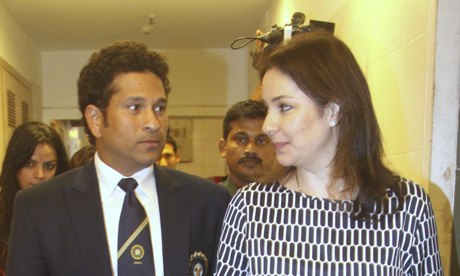

Sachin Tendulkar Anjali Mehta
Sachin Tendulkar, with his wife Anjali Mehta, attends a press conference on the day after his retirement from cricket. Photograph: Ravindra Hande/Demotix/Corbis
Sachin Tendulkar has said recovering from a tennis-elbow injury was the most difficult phase in his career, with the master batsman fearing he would never be able to hold a bat again after surgery in 2005.
The diminutive Indian bid an emotional farewell at his home Wankhede Stadium on Saturday, signing off as cricket's most prolific run-scorer after almost a quarter of a century at the crease.
Tendulkar was first diagnosed with the injury in 2004, but continued to play through pain before being operated on a year later in London.
"It's always very difficult when you suffer injuries. Coincidentally my injuries were not common ones," Tendulkar, sporting his navy-blue India team blazer over a white shirt, said on Sunday. "There used to be different goals every time I made a comeback. It's not possible to recover earlier than scheduled by just working harder in the gym."
The thought of giving up the sport crossed Tendulkar's mind as he tried to get back on the field after the surgery. "It took four and a half months to recover after the surgery on my tennis elbow. The doctor asked if I would be able to play competitive cricket at all," he said.
"I could not even lift my son Arjun's plastic bat. Kids aged 10-12 years had come to the ground for fielding the day I went to bat for the first time against a season [leather] ball. I hit the balls hard but the kids were able to stop them within 10-15 yards. I thought: 'I cannot play anymore.'"
Speaking to reporters at a hotel overlooking the Arabian Sea, Tendulkar said the realisation now that he would never play competitive cricket again was yet to sink in. But he promised to remain associated with the game.
"I have played for 24 years and it has not been 24 hours yet and I believe I have earned at least 24 hours of rest," the 40-year-old said, adding he woke up early as usual on Sunday just to realise it was not necessary. "Cricket is like oxygen for me and 30 years out of 40 I've played cricket, so that makes it 75% of my life. I will remain associated with the game, maybe not in the immediate future."
Tendulkar left the game after playing more Test matches (200), scoring the most Test (15,921) and one-day international (18,426) runs, and compiling more Test (51) and one-day (49) hundreds than any other player in cricket history.
He picked the victory in the 50-over World Cup at home in 2011 as the high point of his career. "I had to wait for 22 years. It was a special moment, also my last day in international cricket," added Tendulkar who was joined by his wife, Anjali, at the news conference.
"Biggest disappointment was losing in the 2003 World Cup final – we were playing so well but could not cross that final hurdle."
India, under Sourav Ganguly's captaincy, reached the final of the World Cup in South Africa but lost to Australia.

sachin profile

Sachin Tendulkar most prolific run scorer in cricket history

Reuters Nov 16, 2013, 01.13PM IST
(Factbox on India batsman…)
MUMBAI: Factbox on India batsman Sachin Tendulkar, the most prolific international run scorer in cricket history, who retired from all forms of cricket on Saturday.
Born on April 24, 1973, in Mumbai. Made his test debut against Pakistan as a 16-year-old, becoming the youngest Indian test player. A year later, he hit his maiden test hundred in England.
Has played the most tests (200), scored the most test runs (15,921), one-day international runs (18,426), and compiled the most test centuries (51) and one-day hundreds (49).
Has also taken 46 wickets in tests and 154 wickets in ODIs.
Had two unsuccessful terms as India captain, the first aged 23 in 1996 before being axed 17 months later after his batting suffered. He was reappointed in 1999 but stood down after a 3-0 test series rout in Australia the following year.
Tendulkar was named player of the 2003 World Cup, scoring a record 673 runs to help India reach the final, where they lost to Australia. In the next year, he equalled compatriot Sunil Gavaskar's world record of 34 test hundreds while compiling 248 not out, his highest score, in Australia.
Named Wisden Cricketer of the Year in 1997.
Surpassed West Indies' Brian Lara as the highest test run-scorer in 2008. Lara had scored 11,953 runs before he retired from international cricket in 2007.
Became the first batsman to score 200 runs in one-day internationals, against South Africa in Gwalior, India in February 2010. He finished on 200 not out off 147 balls with 25 fours and three sixes.
Became the first batsman to score 100 international centuries after stroking a single off left-arm spinner Shakib Al Hasan in an Asia Cup one-dayer against Bangladesh on March 16, 2012.
Announced his retirement on Oct. 10, 2013.
Played his 200th and final test match against West Indies at the Wankhede Stadium, his home ground, in Mumbai from Nov. 14, 2013.
Played his final innings of 74 on Nov. 15, the 24th anniversary of his international debut against Pakistan in Karachi.
The 40-year-old walked off the field for the final time on Nov. 16, 2013 after India beat West Indies. (Compiled by Sudipto Ganguly; Editing by John O'Brien)

Sutherland Ashes preparations

Sutherland defends Ashes preparations


James Sutherland suggested that ODI cricket was better than no cricket. © Getty Images
James Sutherland, chief executive of Cricket Australia, admitted on Wednesday (November 13) that Australia would have no excuses for not doing well in the upcoming Ashes series because their preparation has been far superior to England’s.
Sutherland defended the scheduling of Australia’s recent One-Day International tour to India, saying, “The quick change to the five-day game would have minimal effect on players in next week’s first Test in Brisbane.”
Had rain not ruined England’s tour match in Hobart last week, the three-time Ashes holders would have played three full first-class matches before the Test series. In contrast, some of the Australian Test players have had an interrupted start to the Sheffield Shield season, with the Indian tour and then the scheduling of England tour matches taking leading players out of the domestic fixtures.
Merv Hughes, former Australian selector and fast bowler, recently hit out at Australia’s scheduling. “I am just dumbfounded with England being in town and preparing for an Ashes that starts in about a month’s time and Australia has got a team playing in India, playing in subcontinent conditions preparing for the Ashes,” said Hughes.
“So who’s going to be better prepared come the first Test match? England appears to be doing everything right at the moment.”
However, speaking to a gathering in Melbourne on Wednesday, Sutherland suggested that ODI cricket was better than no cricket. “If Australia lose a fourth straight Ashes series for the first time since 1890 they will not be able to blame inadequate preparations,” said Sutherland.
“There weren’t actually a lot of players who are playing in the Test team in Brisbane who were actually in India, and at the same time there were a lot of players who were back here playing Ryobi Cup (domestic one-day series) and have been able to play in the first couple of rounds of (Sheffield) Shield cricket and have had a really good preparation.
“We’ve had a lot more cricket than England have over the last couple of months, so don’t tell me we haven’t had a good preparation because England have hardly played.”

kumble speech

Focus on the game, the players: Kumble

Anil Kumble ended his lecture by cautioning Indian cricket against repeating mistakes committed by teams that topped the charts previously. © BCCI
Speaking at the second Mansoor Ali Khan Pataudi Memorial Lecture in Mumbai on Wednesday (November 13), Anil Kumble focussed on the processes that needed to be put in place for Indian cricket to develop further and strengthen its position in the global game.
Kumble charted the journey of Indian cricket over the last two decades even as he regaled the audience with stories of his own interactions with Pataudi. “He understood the Indian way and the importance of putting processes in place,” said Kumble. “He was a management guru, long before the term was put to place. He understood the value of symbolism, which in the Indian context is important.”
Kumble also reflected on his three-year stint as president of the Karnataka State Cricket Association, saying that his experience of having played at the various facilities on offer around the country – good and bad – had shaped his thinking. “Just as some areas of the game, like umpiring, were benefited by former players, administration too can benefit from having players who played at the highest level. For one, the focus will remain or should remain, at any rate, on the game and the player,” he said.
Kumble was of the opinion that other sports too could take a cue from cricket. “Infrastructure (in cricket) is now available outside the big cities and so too are the coaches and incentives. Such things can happen in other sports too. Tennis courts in Shimoga or swimming pools in Meerut can produce champions. We owe it to our youngsters to provide the facilities that will attract them to sport,” he said.
Indian cricket has tasted success in all formats in the last decade and expressing his pride at having been part of the core group that laid the foundation for it, Kumble said, “Power equations have shifted and India’s influence is substantial, but this is only natural and a result of the economics that drive sport. The region that generates significant sponsorship and patronage despite the tremendous and, at times, fanatical following for cricket, should certainly have a role in defining the path for the game’s future.”
Kumble went on to praise the “remarkable and unacknowledged” efforts of Board of Control for Cricket in India (BCCI) in bringing international players together for the Indian Premier League (IPL). “Today the Shane Watsons and AB de Villiers of the world are as familiar with naans and curry,” he quipped.
“Players and fans are closer to BCCI’s way of thinking than is realised,” he said, while conceding that he too had reservations regarding the Decision Review System. “We have maintained that the system needs tweaking. We need additional input, not because we’re looking at 100% accuracy every time. In order to eliminate some obvious drawbacks in the system, an expert in technology is needed to certify the science behind it. Yet the perception in this case is that the BCCI is 100% wrong.”
Kumble suggested that cricket needed to adapt to the changing times, especially in connection with the cricket calendar, which, he felt, needed to be balanced according to the market. “We can carve out separate calendars for each format – three different seasons to accommodate three different formats is easily conceivable. India can lead the change here too as they have done with the IPL,” he suggested. “It will also provide clarity for the spectator and allow players to prepare for the different physical and mental demands of each format.”
Kumble also dwelt on another aspect of the IPL that had come into focus in recent times: the temptations – monetary and otherwise – that youngsters get lured by. “It’s not surprising that a fringe cricketer is lured by the riches that can transform his earning many times over. We must be proactive in our efforts to deal with challenges,” he said.
“Every cricketer should go through a mentoring programme that encompasses a wide range of issues that include understanding his role as a professional sportsperson, responsibility as an ambassador of the country, team, family and the cricket board, being a role model for aspiring youngsters, financial management and a clear concept of the effect of drugs, proper assessment of the paths that lead to the game’s disrepute, spot-fixing and similar ills. These preventive mechanisms, through mentoring interventions, can offer lasting solutions against the evils that threaten the gentleman’s game.”
During the lecture, delivered on the eve of Sachin Tendulkar’s 200th Test, Kumble recalled his long association with Tendulkar. “Sachin and I played 122 Test matches together. I never threatened his place in the team as a batsman but I can tell you, he sometimes threatened mine as a bowler. He was such a natural as a legspinner,” began Kumble, eliciting laughter from the audience. “That he has played for so long and with such great authority is testimony to both his passion for the game and his incredible capacity of hard work. Fans see only the final product, the exquisite straight drive or the smooth on-drive, but tend to tend to forget the hours of sweat that went into producing such strokes.
“Sachin is three generations of players in himself. He began when Kapil Dev was spearhead of the attack, he was the contemporary of Dravid, Laxman, Ganguly, Zaheer, Harbhajan, Dhoni and Sehwag, and has placed Indian cricket in the strong capable arms of Kohli and Pujara.”
Kumble said that no other sportsperson symbolised the essence and aspirations of the country as Tendulkar had: “For a great majority of our countrymen, he has been a fixture all their lives,” he said, adding that Tendulkar’s contribution in the dressing room in mentoring young cricketers was invaluable.
Kumble ended his lecture by cautioning Indian cricket against repeating mistakes committed by teams that topped the charts previously, such as West Indies and Australia. “The present belongs to India, there’s no reason why the future too can’t. We owe it to the coming generations to provide the wherewithal to become the best players they can be. And how we handle the present will define the future,” he said.

cricket news

Cricket: Bailey to make Test debut for Australia


George Bailey will make his Test debut in the Ashes series opener at the Gabba starting on Thursday week.
Tasmania skipper Bailey, 31, was selected in a 12-man Australian squad named on Tuesday on the back of his remarkable one-day international form including the recent tour to India where he amassed 478 runs at 95.6 when also serving as captain.
Selectors will be hoping he can provide much-needed middle order stability, much as another late bloomer, Mike Hussey, used to do.
Bailey's first-class record has been a little underwhelming, averaging just 18 last Sheffield Shield season.
But national selector John Inverarity said Bailey got the nod over another Tasmanian Alex Doolan, because of his brilliant recent form.
"It was certainly discussed at great length last night. Of course the national selection panel have been in contact quite a bit over the last few weeks and that had a lot of discussion," Inverarity said.
"Alex Doolan is a very highly regarded player in our eyes.
"George Bailey has been in fantastic form with the bat.
"His confidence is riding high, his performance in international one-day cricket has been quite extraordinary and he's very deserving of this opportunity."
David Warner retains his spot at the top of the order, partnering Chris Rogers, after thrashing four centuries in the past month, including 104 off just 88 balls for NSW against Victoria in last week's Sheffield Shield clash at the MCG.
And Mitchell Johnson returns as Australia's third paceman alongside Ryan Harris and Peter Siddle.
The 32-year-old left-armer last played Test cricket in Australia's fourth Test loss to India in March and will be keen to further distance memories of his 2009 Ashes series struggles in England.
"He's in good rhythm and bowling with good pace, so we're confident he'll acquit himself very well and be a bowler to the fore in our attack," Inverarity said.
Nathan Lyon is the Test spinner after selectors overlooked Victorian leggie Fawad Ahmed.
Allrounder James Faulkner is included as the likely 12th man and cover for Shane Watson, who is carrying a hamstring injury.
Inverarity said Australia were confident of Watson being able to bowl in the first Test, but couldn't be 100 per cent sure nine days out from the match.
Faulkner isn't necessarily being seen as Watson's shadow however, with the possibility he could be used as a fourth seamer if conditions were conducive to pace.
"I think on that squad of 12, we've got considerable facility there," Inverarity said.
"You'll be able to determine that we could play five batsmen and five bowlers, or we could play four quicks and no spinners, or three quicks and one spinner.
"Shane is progressing very well in regaining his fitness and we're confident he'll be fit to play.
"We're not sure as yet, because it's nine days to go, to which extent he'll be able to bowl."
England are vying for a record fourth straight Ashes series win, having won the last series 3-0 at home earlier this year.
Australian squad: Michael Clarke (capt), David Warner, Chris Rogers, Shane Watson, Steve Smith, George Bailey, Brad Haddin, Mitchell Johnson, Peter Siddle, Ryan Harris, Nathan Lyon, James Faulkner.

Watson bowling crease

Watson returns to bowling crease

November 18, 2013
Comments: 38 | Login via | Text size: A | A

Shane Watson considers himself a strong chance of resuming at the bowling crease during the first Ashes Test, the major question a matter of when. In the latter phase of his recovery from a hamstring strain, Watson took his first tentative steps towards bowling at Allan Border Field on Monday, and will build up further as the Test creeps closer to the toss on Thursday morning.
Watson told ESPNcricinfo he was keen to bowl in the critical first encounter of a series in which he will hope to play a pivotal role with bat and ball, but was also enjoying the fact he was not under pressure to be fit to bowl on the first morning of the match, in contrast to last summer when he was left out of the team to face South Africa for two Tests on the basis that he needed to bowl to earn his place.
"It was nice to be able to roll my arm over and see how I pull up tomorrow, which I'm sure will be okay, and just gradually building it up to see what capacity I'll be at for the Test match," Watson said. "Potentially absolutely [I will bowl in the Test], the great thing is the pressure's not on me to make sure I'm pushing to bowl on day one if we bowl.
"It will just depend on how I continue to go over the next few days and get a gauge on what capacity I'll be able to play. Everything's progressing really well at the moment, but I'm not putting a huge expectation on me being able to bowl a huge amount in the first innings, it is more seeing how it progresses to get the balance right between getting as close to full capacity as I can without heightening the risk of re-injury."
Australia's physio Alex Kountouris had opened the possibility of the allrounder being able to reach his top gear at some point during the match. While Watson's bowling was decidedly gentle, off a handful of steps, the sight of his return to the crease re-opened the hosts' selection options for Brisbane as they ponder the inclusion of Nathan Lyon or James Faulkner.
The hamstring strain occurred during the final match of the recent ODI series in India when Watson was moving into his delivery stride at the Chinnaswamy Stadium in Bangalore. Watson said he was not inconvenienced by batting or running, leaving only the motion of bowling his fast medium swing and seam to be negotiated at training.
"Doing running between the wickets has been absolutely fine so far, it's mainly just the bowling aspect, how I initially hurt it, which is trying to get that perfect balance," Watson said. "If I'm not feeling it batting-wise like I did during that last one-dayer then I'm certainly confident it won't get hurt batting."
Kountouris, who has groaned and grimaced as much as anyone over Watson's litany of calf and hamstring ailments in recent years, offered an optimistic view of his recovery, noting that the fact he had been bowling consistently until suffering the strain meant less strength and conditioning work would be required to get him up to speed. This contrasted with the bowling coach Craig McDermott's view that a return in Brisbane would be unlikely, leaving Watson and his captain Michael Clarke to consider their options.
"The thing is he's only stopped bowling two weeks ago," Kountouris said. "He could just as easily have had a rest for 10 days and then come back to bowling so we're not too worried about building him up with workloads. He's going well with his rehab, he's on track to play the game obviously, he was running today, he's been running since last week. He did a little bit of bowling today so that's in the infancy but he's going well at the moment.
"He's on track to be bowling in the next week so which means he might bowl in this Test match if he keeps making good progress. He hasn't had a long-term injury, so getting him up and going again is the most important thing and really he's just got to get through a couple of sessions and then he can bowl some balls in the game. Probably not going to bowl 40 overs, but he can bowl some balls."

Shane Watson appeals for the wicket of Joe Root, England v Australia, 4th Investec Ashes Test, Chester-le-Street, 1st day, August 9, 2013
Shane Watson delivered linking spells usefully in England © Getty Images
Enlarge
Watson's fitness to bowl has implications for plenty of players around him in the Gabba squad. If he is unable to fulfil the duties of the fourth seamer the position of Lyon comes under increasing threat, given the likelihood of a grassy surface due to recent heavy rain around Brisbane and the presence of Steven Smith and Clarke as potential part-time spinners.
However, a clean bill of bowling health would permit Clarke to employ Watson in the linking spells he delivered so usefully in England, allowing the pace vanguard of Ryan Harris, Peter Siddle and Mitchell Johnson some respite while allowing greater latitude for Lyon's flighted offbreaks.
"I was batting at the time but I heard he bowled and they came out well so everything's okay," Smith said. "Hopefully he pulls up well tomorrow and can do a bit more because he's certainly going to be valuable if we can get 10 overs out of him in an innings at the Gabba. He was invaluable in England and if he do that again here it will be great for us."
Lyon possesses a fine record in the two Tests he has played in Brisbane, scooping 11 wickets at an average of 24.09 across matches against New Zealand and South Africa. Typically team-oriented, Lyon said he would be happy to bowl tightly on a surface more favourable to fast bowlers.
"That's going to have to come down to the conditions," Lyon said. "If it's turning a lot I'll be more attacking, but if it's not turning as much and if it's seaming I might be thrown the ball to do a containing and holding role so we can rotate our fast men from the other end and try to create some pressure. That's going to be game-dependent, and talking to Pup (Clarke) when and if that circumstance arises.
"I'm happy to do whatever role it takes for Australia to win a Test match. I'm all for the team, I don't care who's taking the wickets. If Ryan Harris takes five and six wickets, I take none for the game and we win the Test match I'm over the moon. I'm happy with whatever role Michael Clarke comes up with and hopefully I'll be able to take that and help get wickets from both ends."

cilchrist commands about sachin

Sachin “will move comfortably into life post-cricket”: Gilchrist


Adam Gilchrist also backed Rahul Dravid’s recent demand to legalise betting in India. © Getty Images
Shuja Khan basked in the attention on Wednesday (November 13), after having become India’s first recipient of the Bradman Scholarship to study at the University of Wollongong in New South Wales. What made the occasion more special was that he shared the stage with Adam Gilchrist, the university’s brand ambassador, someone used to being in the limelight.
And it wasn’t long before the discussion veered towards Sachin Tendulkar, currently at the centre of India’s cricketing universe as he prepares to play his last Test match, and Gilchrist was confident about Tendulkar adjusting easily to life post retirement. “Sachin will have plenty of opportunity post his cricket career. He is an MP (member of the Rajya Sabha) now, so he has little bit of that to concentrate on. I think he will move comfortably into life post cricket,” said Gilchrist. “He has handled that (the demand for his time) exceptionally well throughout his career and I expect (him) to do the same post his cricket.”
Gilchrist singled out the 1999 Boxing Day Test as to when he first took note of Tendulkar’s class. “When he scored a hundred (116) on the Boxing Day when the rest of the order was falling around in difficult conditions overseas … that was a sign to me that this guy is truly class. You knew you are in the presence of greatness,” he said.
Away from India and Tendulkar, with the Ashes series scheduled to start in Brisbane on November 21, Gilchrist suggested Australia should not experiment much with the side’s composition in their bid to reclaim the urn. “England start as favourites but if Australia can maintain that core group of players and not be chopping and changing as has been the case in the last 18 months then there is definitely a chance of regaining the Ashes,” he said.
Gilchrist believed that with Darren Lehmann around, the environment in the dressing room would be stable, and backed George Bailey to come good after he was picked in the Test team for the first time. “He (Bailey) has been in terrific run-scoring form here (in India, where he scored 478 runs in the recent One-Day International series), but the conditions there will be a lot of different against England at the Gabba,” pointed out Gilchrist. “The great thing about scoring runs is that it does not matter where you score, it brings great confidence and so he will be very confident going into the series.”
Gilchrist agreed that, of late, Australian cricket has gone southwards and underlined the need to resurrect the team’s image. “We went through a period of time when, without being arrogant about it, we could have picked a couple of Test teams, which would have been very competitive on the world stage. There is an element of cycle to it,” he said.
“It has been widely acknowledged that the Australian team may have cruised through a little bit in our development of young players. A desire for result in Sheffield Shield has somewhat restricted the development at the Test level. Cricket Australia is very aware of that and is keen to get back to the past and identify what it requires to produce good Test cricketers. That is what the end result needs to be. It shouldn’t be winning a game of Sheffield Shield cricket at the expense of developing a player.”
On to other matters and Gilchrist, known as a ‘walker’ during his playing days, didn’t blame cricketers for choosing not to walk but called for the technology available to help officials to be improved. “Players have or haven’t walked forever and long into the future,” he said. “If technology is not working and is not consistent then don’t worry about having it. But that is an argument that is gone. It is here to stay and it is a matter of finding out how best we can (improve it).”
Gilchrist also backed Rahul Dravid’s recent demand to legalise betting in India, saying, “I support his comments. Anything to discourage what we know has been going on – outside influences tempting cricketers to underperform in whatever capacity – we need to try and encourage to stop it.”
Gilchrist, who retired from competitive cricket after picking up a wicket off his first and only delivery in Kings XI Punjab’s 2013 Indian Premier League campaign, stressed on the need for the IPL’s governing council to level the playing field before the next year’s auction. “There certainly does not seem to be an even balance as for the capacity of each of the team to turn up at the auction and be on a level playing field,” he said. “That evenness of competition is something that needs to be maintained and it is difficult when big corporations are bidding against a small conglomerate of syndicate groups as owners. That’s a great challenge for the governing body.”
Gilchrist hoped that other franchises could take a leaf out of Chennai Super Kings’ book in order to build a loyal fan base. “Chennai can particularly take great credit for their consistency over six years in their recruiting formula and their ability to build a foundation around a group of players,” he said. “It is crucial that we don’t take it for granted that they (fans) will continue to support teams that have chopped and changed so much. That level of loyalty needs to be there. At least six players being able to be retained (will be ideal). If we go too many more than that then it probably leaves with the status quo of a couple of teams being a bit too dominant, a bit too top heavy with all the talent.”

Comments